


The first part of the Wicked movie was a peerless entry into the movie musical oeuvre. Through its swelling songs, its visual delights, and the intense chemistry between its two leads, Cynthia Erivo and Ariana Grande, who played Elphaba and Glinda, respectively, the movie created a veritable phenomenon —a film that transported you fully out of your seat and into the fantastical land of Oz. And so, when it came to the second half of the movie’s duology, Wicked: For Good had a big slippers to fill. Ultimately, more due to the fault of the source material than any fault of its own, Wicked: For Good couldn’t fully recapture the magic of the original, but it still provided us with a beautiful, emotional, and thoughtful conclusion to the adventure.

It’s a well-known fact, even among Wicked‘s most die-hard fans, that the musical is simply front-loaded. Most of the popular bangers of the production take place in the first half of the story, and that’s the truth of the situation. While the movie tried to even the playing field with a handful of new Wicked songs, which admittedly helped the narrative, the numbers fell flat sonically and
aren’t very memorable. In addition to this obstacle, Wicked: For Good had to take on the “Everything Goes Wrong in the Second Act” syndrome that many musicals fall prey to. While the first part of Wicked offers lighter, more fanciful fare that lends itself well to situations where singing and dancing abound, events grow darker in the second half. The story simply doesn’t allow for the escapism whimsy that was the most powerful strength of Wicked‘s first movie. Instead, no one is happy and everything is dour, devastating, and falling apart. And so, I think it is important for audiences to level set their expectations around these big diversions from Wicked: Part One.

All of that said, Wicked: For Good is, well, a good movie. It might not be stratospherically perfect like its predecessor, but everyone who enjoyed the first Wicked movie will also enjoy Wicked: For Good. In many ways, while Wicked was the story of Elphaba’s triumph and Cynthia Erivo’s stunning vocal chords, Wicked: For Good shifts the focus more to Glinda’s journey to becoming who she truly wants to be. And Ariana Grande really raises her vocal game as well in deference to this.
The pair, as ever, make the relationship between Glinda and Elphaba wholly compelling as they navigate standing on opposing sides of the central conflict while yearning for connection with one another. The two actresses masterfully navigate shifting from banter to blows to clutching one another in the space of a scene. There’s this beautiful core of friendship that always seeps out and intertwines them, even in their darkest moments with one another.

Of course, we have to make some space for our sexiest man of the year, Jonathan Bailey, who retained Fiyero’s charm in Wicked: For Good, but let us truly see the growth and change in him from his first iteration. Seeing Bailey’s Fiyero and Erivo’s Elphaba finally come togther to reveal the truths in their hearts was immensely satisfying.
Overall, though some aspects of the plot required major hand-waving (Why couldn’t Elphaba just get rid of the wizard? Why couldn’t she just save Fiyero at a critical moment?), most of the character arcs rung true. For some, Elphaba’s road to true love, to being chosen, and to finding inner peace away from the normative society that rejects her will call loudly. While to others, Glinda’s journey to marry goodness with her love of the spotlight, and find that she really only needs herself to soar, will whisper more truly. Both are compelling stories explored by Wicked: For Good.

Then there are the musical numbers. While, as we mentioned, Wicked: For Good doesn’t contain the same quanitity of vertiable hits as the first Wicked movie, it is widely known to have two of the best songs from the musical, “No Good Deed” and “For Good.” And we’re happy to report that both these numbers were exquistely executed. “No Good Deed” arrived in all its vengeful, angry glory, complete with erupting flames, a cacophony of flying monkeys, and the kind of intensity of spectacle that only cinema can deliver. And, all wrapped up in Cynthia Erivo’s pipes as it was, it was truly breath-stealing. In sharp contrast, no good with simple, sweet, and left at least five people audibly sobbing in the theater.
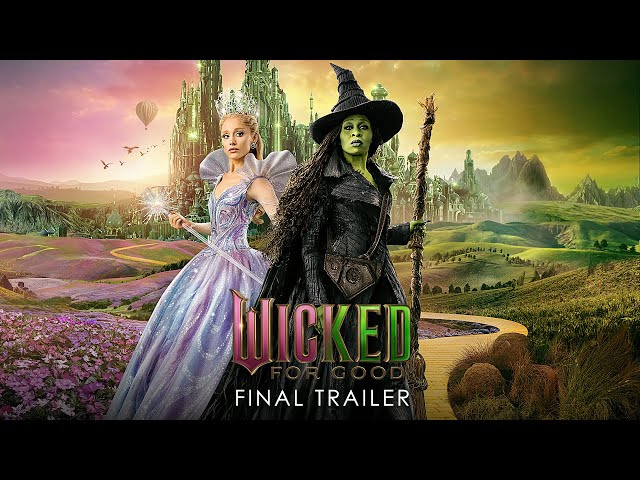

While some of the other songs were not as wholly memorable, the movie did make good on recreating its world-building from the first film. The sets, costumes, hair, makeup, and more were all stunning artpieces from a different land.
As I conclude, I will share that I think the one great flaw of Wicked: For Good and Wicked the movie as well, is its reluctance to just give into the flow of the river or, in this case, the path the yellow brick road is pointing. Wicked always feels incredibly queer-coded, but Wicked: For Good feels like it’s just DYING for that last barrier of normativity to lift and allow Glinda and Elphaba to kiss as the music swells around them. The tension to pull away from that actually feels palpable, and it really makes the ultimate relationships between all the characters weaker.

Are we really to believe that Fiyero left Glinda at the alter only to immediatly fall into bed with Elphaba, but didn’t love them both? There’s one flashback where the three of them are on a picnic and Fiyero smiles broadly at them as they giggle and whisper together. And it just really feels like everyone is in love. Wicked: For Good, I feel knows this, in the way Glinda and Elphaba hold one another. In the way, they tell one another they love each other. In the way, rainbows appear left and right. But it can’t embrace it fully, which feels, more than anything like the movie’s one true shame.

Ultimately, Wicked: For Good was a captivating, emotional movie—full of heart and incredible singing. We can safely say that watching it changed us… For Good.
Wicked: For Good is now in theaters.