


Maggie Gyllenhaal’s The Bride is a captivating movie. Right from its very first moments, this film knows how to hook its viewers, immerse them in its world, and so thoroughly entertain them that they’ll never want to leave. The Bride is not a shy and retiring movie. It begins right in your face, with a stunning monologue delivered to perfection by Jessie Buckley. The opening scene is a ghostly, rich, cackling, nuanced introduction to The Bride. And, stunningly, it’s stripped bare, just a black and white vision of one woman on a screen addressing you directly. With confidence, it relies on only the essentials to make its first impression. And with the simple strengths of its smart writing, gorgeous cinematography, and profound acting, it steals your breath away. And that’s just the first five minutes. The Bride is everything cinema should be.
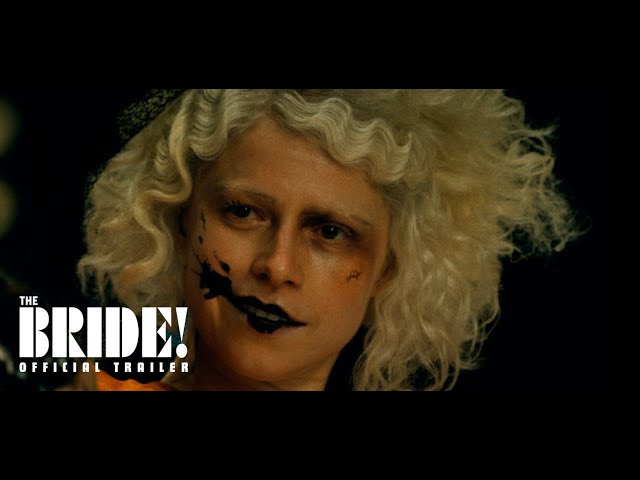

The Bride, at its core, is a retelling of the story of Frankenstein’s Monster and his bride, first brought to screens in 1935’s The Bride of Frankenstein. While The Bride never speaks in her 1930s outing, The Bride‘s Bride has A LOT to say, as she navigates her reanimation, her new perception of herself as a monster from within and without, a loss of her human memories, a romance with Frankenstein’s Monster, known as “Frank” in this film, Mary Shelley’s voice inside her head, her newfound power, and, of course, the question of her sense of self. “Who is The Bride?” is a question that haunts the narrative at every turn and drives the heart of the story.
The opening scene of The Bride smartly sets up the whole movie with one important conceit: Is The Bride a ghost story, a horror movie, or the most terrifying thing of all, a love story? And, of course, The Bride, in the end, is all of these things to great effect, truly recapturing the essence of a true gothic romance but remixing them with a really strong, modern sensibility.
There are all the hallmarks of the darkly romantic genre: gorgeous, decrepit buildings, strikes of lightning, ghostly possessions, and the twine of blood-stained fingers together. There are also true terrors and visceral violent acts, although that doesn’t always come from the monsters themselves. And a love story, of course. There’s the obvious love story between Frank and The Bride. But then, there’s the love story that sets The Bride apart from many others, the modern love story, the unconventional love story, the, as the movie presents, most terrifying love story of all… The love story with yourself.

As The Bride finds her voice and begins her search for belonging and freedom, the most important relationship she prioritizes is with herself. It’s interesting how rare it is for one’s relationship with themselves to be centered in our fictions, especially if that self happens to be a woman. But as The Bride stubbornly embarks on a journey to understand herself, The Bride underscores how critical this story is and how it can touch others along the way.
And that impact extends beyond just moving The Bride herself, or the women The Bride meets on her journey, or influences by standing in her strength, it reaches all the way out those sitting in the audience. And clearly, it’s meant to, as both The Bride and other women in the movie are granted the ability to gaze past the bounds of their narrative and right into the faces of the crowd in the theater watching them. In that way, anyone and everyone is invited to become a bride of their own.

In fact, not hours after I watched the movie, I found myself echoing The Bride’s favorite refrain, “I would prefer not to,” when setting some personal boundaries for myself. The phrase, borrowed from another literary work, Herman Melville’s “Bartleby, the Scrivener,” but reimagined as a critical aspect in The Bride’s fight to put herself first, had done what it had intended to, and crept from her mouth out of mine.
In this way, and many others, Gyllenhaal is someone who very keenly understands that the medium of and the act of going to the movies at its finest should offer both an escape from and a mirror to reality—and sets The Bride up to create exactly this call-and-response. Just as Frankenstein’s Monster, known boldly in this movie as “Frank,” goes to the movies to imagine himself in a different life, but also pulls from the movies to enhance his own, so, too, is the audience invited to find catharsis in The Bride. But not without both offering a part of themselves to the movie, and drawing a part of the movie back out into the world in themselves. The Bride offers both a gorgeous, romantic fantasy to lose oneself in and a critical commentary on our own daily experiences that feels inescapably thought-provoking. It’s a powerful movie-going experience.

Additionally, it’s clear that The Bride is a movie carefully crafted by a person who loves movies. Maggie Gyllenhaal paints her vision in bold, lush strokes that never pull a punch, but always deliver it in the most aesthetically satisfying and narratively fascinating way, the movie’s twists and turns landing with precision and smoothness. All of this marries with the delicious aesthetic of the movie, a specific energy that touches everything from The Bride‘s black, chemical-stained lips to its new take on a monster-making laboratory to its stop-offs in gorgeous abandoned places, grungy clubs, upper-crust soirees, and, of course, all kinds of 1930s-esque movie theaters.
It’s also worth noting that never have I seen a camera love an actor the way the camera loves Jessie Buckley in The Bride. Gyllenhaal transforms the actress’s already powerful presence into a sublime, supernatural being that, like all of us, is some parts monster, some parts divine. And Buckley truly shines in her three, yes, three different roles.
In The Bride, Buckley takes on The Bride, The Bride’s human form, Ida, and Mary Shelley herself, who sometimes guides The Bride in her mind and sometimes steps into The Bride to offer some unsaid thoughts of her own to the world. For each character, Buckley dons a different accent and different mannerisms, and each is quite distinct. It’s a tall order, and Buckley pulls it off to perfection. As The Bride, Buckley also manages to be both incredibly otherworldly and harrowingly vulnerable in the most human of ways. The delivery of these combined elements really transfigures The Bride into a character that leaps off the screen, fully realized and finished from every angle.

Meanwhile, Christian Bale does Frankenstein’s Monster, “Frank,” full justice. Stepping into a role that has been imagined over and over again is no small task, but Bale delivers a fresh take on The Monster. This vision of the character does not absolve him of his worst tendencies but, at once, invites us to feel the crushing, aching loneliness such a singular figure must hold so superbly that we hope for its absolution. Bale’s performance as Frank is one of the most nuanced portrayals of Frankenstein’s Monster we’ve seen in the history of Frankenstein. As with The Bride, the vulnerability of Frank, the innocence that kisses him despite his monstrous form, and his true desire for connection and love, sometimes in the saddest of ways, truly resonates.

To me, Frank’s one-sided, imagined relationship with movie star Ronnie Reed, played by Jake Gyllenhaal, is one of the most heartbreaking elements of the movie. Bale so skillfully pulls it off. He reveals to viewers the depths of what Reed means to Frank in a wholly pure way—at times, giggling giddily to see him on the big screen, at others, clutching a newspaper clipping with Reed’s face on it like a security blanket. And it touches us even as the audience knows that meaning doesn’t really exist.

Speaking of Reed, the musical numbers twined into The Bride are superb. The sudden shifts into Fred Astaire and Ginger Rogers-like musical numbers, again, made the movie feel like a truly cinematic experience. The dancing scenes are fun and free, and make total sense in a movie that is all about searching for freedom. They are also just incredibly beautiful and bring old Hollywood back to life before our eyes. The main dance sequence between Frank and The Bride, less polished and more monstrous than some of the others, but still so unbound and glorious, spins a kind of arcane power into the world. Not just over the other captivated denizens of the room in the movie, but over everyone in the theater. Who wouldn’t want to get up and dance with Frankenstein and The Bride?

While the parts of the movie with The Bride and Frank were utterly compelling, the mob subplot in The Bride felt a touch underdeveloped, almost an afterthought, though it helped tie the core narrative together. Penélope Cruz and Peter Sarsgaard were still very good in their roles. And I very much enjoyed Cruz’s turn as Myrna Mallow, a sharp lady detective. Mallow, in many ways, has a struggle that’s kindred to The Bride’s and offers yet more dimension to the movie’s core story. Peter Sarsgaard’s Jake Wiles, meanwhile, offers a nice tale of how one can do wrong, but then seek to do better. But ultimately, I felt the mob/detective plot could have been developed either more or less; where it ended up, though, was a bit shy of impactful.
Additionally, it feels fair to warn that there is quite a bit of sexual assault in the movie. Maggie Gyllenhaal has spoken about its inclusion in the film in such distressing ways and shared why she deemed it necessary. I respect the purpose and the thoughtfulness behind the decisions, but for me, it was still a little difficult to stomach at times.

Ultimately, though, The Bride is what going to the movies is all about. As I sat, alone now, in the theater, with the credits rolling across the screen, I felt filled with the kind of sweeping emotion that can only come from a truly satisfying outing to the cinema. The Bride had touched me, and I was just the first of many. It certainly didn’t hurt that “The Monster Mash” played to see the movie out; a song all about the beauty of relishing in your monstrosity, dancing in your weirdness, and embracing a good time. It was one last grace note from Maggie Gyllenhaal.