


How could a young boy who drowned decades ago suddenly return as a full-grown man that is all but immortal? Horror fans have been asking that since Jason Voorhees claimed his first victim. There are plenty of theories to explain is otherwise inexplicable existence. One entry in the franchise even presented a canonical answer for how this legendary slasher keeps returning from the grave. The problem is none of them are compelling. Some are too far fetched while others undercut the series’ first film. But I think there’s one concept that explains his supernatural life without the use of retcons or implausibilities. It’s rooted in Friday the 13th‘s foundation. It also makes sense across the series’ many sequels: Jason is the physical manifestation of his mother’s rage.

The original Friday the 13th gave us one of the genre’s greatest villains in Pamela Voorhees. She sliced and diced her way through Camp Crystal Lake not with demonic super powers, but with pure fury. Pain drove Pamela, the unimaginable pain of losing her child under horrible, wholly avoidable, totally unforgivable circumstances. Her grief didn’t abate with time, either. It grew stronger over the years, turning a once loving mother into a sociopathic murderer.
None of that is in dispute. None of that needs an explanation, either. Everything about Pamela’s story and the original film makes sense and is easy to understand.
(That includes the intentionally ambiguous introduction of Jason as a young decomposing corpse who emerges from the lake to pull Alice from the canoe. Whether that Jason is real or a delusional Alice’s dream doesn’t matter. It’s about how the events of that weekend will haunt her forever.)
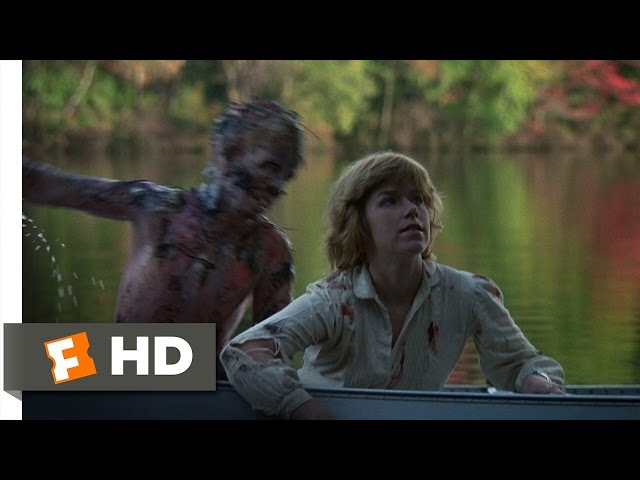

What happened after Pamela died? Suddenly, in the second film, without explanation, Jason is alive and fully grown. A few movies later, we learn he’s not just strong and hard to kill, he’s a supernatural monster. How? How did young Jason drown, possibly return as a reanimated corpse, and then instantly appear as a big giant killer with magical powers? And then how did he keep dying and coming back again and again?
This is the enduring question Friday the 13th devoted fans have long tried to answer. One popular fan theory says Jason simply never drowned. Confused, he instead lived in the woods until he saw his mother murdered, driving him to kill. That theory has so many obvious problems before you even get to the supernatural stuff, it’s hard to take seriously even if it does solve one big problem. The same is true with the theory that posits Jason was already supernatural/demonic before he drowned. That’s not just a stretch, it also undercuts the horror of Pamela’s story. In that case, Jason wasn’t a sweet child who needed protection. He wasn’t even fully human. There’s nothing in the first film that supports that, and adding that to the original movie makes it worse, like most theories that try to make sense of Jason do.

Even fans who endorse these ideas recognize they can be inconsistent, incomplete, or fundamentally flawed. And yet, they’re better received than the one installment that did try to officially resolve this question in an all-encompassing way. Jason Goes to Hell director Adam Marcus had a character find The Evil Dead‘s Necronomicon (a prop Marcus got from Sam Raimi directly) inside the abandoned Voorhees house. It wasn’t in the background of a scene as a little Easter egg, either. It’s prominent.
While Marcus couldn’t explicitly make the connection onscreen because of rights issues, he believes the book’s presence told an obvious story. It’s one he says explains Jason’s existence. Here’s what Marcus said to Horror Geek Life about the horror crossover that essentially makes the infamous slasher an undead spirit known as a Deadite:
She [Pamela Voorhees] makes a deal with the devil by reading from the Necronomicon to bring back her son. This is why Jason isn’t Jason. He’s Jason plus The Evil Dead, and now I can believe that he can go from a little boy that lives in a lake to a full-grown man in a couple of months, to Zombie Jason, to never being able to kill this guy.

Even if fans loved Jason Goes to Hell: The Final Friday (which, uh, they do not) this is a clear retcon that creates a bigger problem than it solves. It explains how Jason instantly goes from a boy to an adult man. It also explains how, since he’s really a parasitic demon spirit, he keeps coming back from the dead to kill people. That would even explain why Pamela and her son seem to have a telekinetic connection.* But it does all of that by ruining Pamela’s own story and the first movie, which is very intentionally not supernatural. It turns her humanist tale of a grieving mom driven to madness into one about a de facto satanic witch. One of those is interesting. The other is not.
Unlike the fan theories, which are flawed but fun, “canonical” Deadite Jason is an answer that technically makes sense but makes the whole franchise worse.
*I don’t think this is a thing and therefore doesn’t need an explanation. But it’s a fun theory with some merit.

What makes the franchise better is embracing the very sad, relatable Friday the 13th is built on. Pamela Voorhees’ rage is the most real, easily explained thing in any movie. It makes more sense than anything that happens after she dies. And that’s exactly why her death is the best explanation for why her son returned.
Jason didn’t reappear until after his mother died because Pamela’s grief and anger didn’t die with her. Like a demon who won’t stay dead, it can’t ever be defeated. It gave him life because Jason is not human anymore, he is the physical manifestation of his mother’s rage. He is pain and anger made flesh. He is more like a powerful idea you can never kill no matter how hard you try to bury it, chain it at the bottom of a lake, or chop it up until its unrecognizable. Eventually the strongest ideas come back with a vengeance. Just like Jason.
In the Friday the 13th sequels when Jason comes back from the dead a character suffering from pain, anger, or trauma accidentally unleash Jason Voorhees on the world. His existence, while seemingly inexplicable and supernatural, makes sense when you realize it’s not caused by the devil or evil books. It’s caused by the same thing that led his mother to kill, human suffering.

The suffering began when those counselors didn’t pay attention to a young boy. That suffering, rooted in absolute love, led to a rage so strong that when Pamela Voorhees died, it lived on. It endured despite every effort to kill it. And it manifested as a being that encompasses both her love and her anger.
“Why” and “how” does Jason Voorhees exist? “What” is he? He is more than Pamela’s son. Her death gave birth to him. The undead adult version of him is her rage—powerful, hateful, and pure—a feeling so strong and impossible to comprehend it defies logic and explanation. It simply “is,” same as Friday the 13th‘s killer who can’t stay dead.
Mikey Walsh is a staff writer at Nerdist. He swears he (mostly) doesn’t condone the actions of Pamela Voorhees. You can follow him on Bluesky at @burgermike. And also anywhere someone is ranking the Targaryen kings.