


Fallout season one on Prime Video was so perfect that it wrote itself the tallest order for season two. Could more of the show match the pitch-perfect tone, the tight story, the unfolding mysteries, and the incredible character journeys of the show’s first chapter? Well, we’re happy to share that for the most part, yes! And we might even dare to suggest that Fallout season two’s later episodes are some of the series’ best so far. While this season occasionally gets distracted by side quests, in a way it didn’t in season one, the show’s trajectory remains atmospheric. In Fallout season two, we gasped, we cried, we cackled, we cringed, as the stakes got higher, the world got bloodier, and the story got even better. Join us as we return to the wasteland and offer our spoiler-free Fallout season two review of episodes one through six.

As we know from the end of Fallout season one and the tantalizing trailers we’ve seen for season two so far, Fallout‘s second season takes us into the world of Fallout: New Vegas. Of course, Fallout: New Vegas is widely considered by fans to be the best of the Fallout games, so entering its domain could not be done lightly. And, overall, I would say the fusion of game and series went well, although a little less seamlessly than season one’s rendition.
By and large, many of the New Vegas Easter eggs and references feel like they carry actual meaning for the story in Fallout season two. They have a heft to them and hint at plots that, if not currently realized, will become critical to the wider world of Prime Video’s Fallout. But occasionally, a few feel like they exist just to exist. That said, there was really only one major game-oriented swing that we felt missed the mark. One of the factions we were excited to see brought to live-action arrived in a bit of a non-sequitur fashion. The cool appearance didn’t really amount to much beyond showing off a piece of the game. But, then again, game players go on side quests all the time, and if we think of this turn as a nod to how a player feels, we’ll allow it in a meta way. Happily, any of these slight aberrations concluded early in the season, and the series is seamless after that.

But ultimately, as we said when we discussed Fallout in season one, what we love most about the Fallout series is not necessarily what is adapted from the games, but what the series confidently adds to the franchise’s canon. A good adaptation doesn’t just borrow from what’s already been created, it creates for the world it belongs to. Fallout season one did this in an OUTSTANDING way. And Fallout season two continues this tradition. Its biggest mystery hinges on a purely series-created story that fearlessly links back to known characters from the games. As Fallout did in season one when it gave Vault Boy an origin story, Fallout season two is not afraid to create MORE story for parts of the games that already exist. And that’s truly where the series shines. We love the unexpected links Fallout season two draws between different game ideas. We adore the questions it raises. And we eagerly anticipate the answers it promises.
And in this vein, we must bring up Mr. House. In Fallout season two, we see Mr. House in the flesh for the first time. In Cooper Howard’s past storyline, set before the Great War, we meet Mr. House at the height of his glory. And when we say that Justin Theroux could not have played this role to greater perfection, we mean it as emphatically as you can imagine. Justin Theroux’s Mr. House is terrifying, he’s charismatic, he’s ruthless, and sometimes, he’s even vulnerable. And, oh my god, Mr. House’s chemistry with Walton Goggins’ Cooper Howard is off the charts OUTRAGEOUS. When the pair share a scene, it makes your breath catch in your throat. Even though you’re only watching through a screen, the very air around YOU becomes tense, dense, and charged—ready to explode. I have not seen scene partners have this much electricity in a long time.
Necessarily, Fallout season two has to expand Mr. House’s character in the series. Never before had his physicality been explored, nor his journey before he became a supercomputer at the end of the world. Although Mr. House’s whole personality remained in existence in Fallout: New Vegas, there’s just something different about a character in their human body. Justin Theroux’s Mr. House is also the first character to come directly from the games in the Fallout TV series. And the show absolutely nailed this first volley into adapting existing characters and evolving them.

Mr. House wasn’t the only extraordinary character in Fallout season two, though. All the returning characters brought their absolute A-game. Ella Purnell continues Lucy MacLean’s journey from naive vault dweller to hardened Wastelander, beautifully maintaining both the old and new versions of Lucy in her performance. Meanwhile, Aaron Moten once again delivers a very endearing turn as Maximus, a person with a beautiful heart doing his best in difficult circumstances. Sometimes Maximus makes questionable choices at best, but ultimately, he wants more than anything to be noble and good. And that really makes him the purest character in Fallout season two. Of course, Kyle MacLachlan is superb in his role as Hank McLean. Hank has his disguise fully off now, and his smiling, company-man “nice” evil seeps a chill right into your bones every time he’s on screen. More than anyone, Hank makes you feel unsafe when you’re watching Fallout season two. And that’s a testament to the story, the performance, and the character.

Then, there’s Walton Goggins as The Ghoul/Cooper Howard. In Fallout season two, Walton Goggins remains one of the best performers out there, inhabiting one of TV’s best roles. This season, The Ghoul’s vulnerability really shines in a way it didn’t in season one of Fallout. And all The Ghoul gals like me will be happy to see it. In both the past and the present, The Ghoul is a victim of circumstances out of his control, and they are taking their toll on him in many different ways in Fallout season two. There are a slew of wonderful scenes, but two incredible sequences that mirror one another, one in the past and one in the present, flash to our minds. In them, Cooper Howard/The Ghoul falls prey to forces greater than he, and we watch in abject terror/heart pounding/with tears in our eyes to see if he’ll be able to survive the storms that overtake him. Needless to say, Walton Goggins’ performance in Fallout season two is award-worthy.

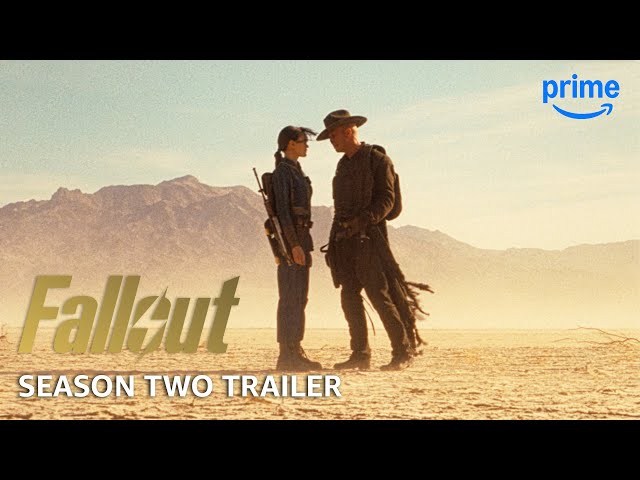
And yes, we know some of you want to know, The Ghoul and Lucy’s friendship does feel like the heart of Fallout season two, in many ways. We spend a lot of time in scenes with them together, and the slow way they change one another is definitely one of our favorite facets of the season. It’s not always smooth sailing for this duo, but both their squabbles and their teamwork are very enjoyable to us. In some ways, both The Ghoul and Lucy are going through the worst parts of their existences in Fallout season two, and they’re doing so together.

Beyond the main crew, Fallout‘s minor characters shine in season two. What could be nothing sequences are enriched by the varied motley crew that Fallout writes so well. Steph and Chet, the Vault Dwellers of Vault 32 and 33, Norm and his new friends, Thaddeus the Ghoul, and even The Snakeoil Salesman, all bring a uniquely fun piece of patchwork to the quilt, making the world of Fallout season two rich and varied.

We also have to add that the look of the Fallout series remains spectacular in season two. From the wacky ways of the Wastelanders to the classier new vaults we get to see in season two, from its pitch-perfect sci-fi vision of the ’40s to a decrepit New Vegas, everything from Fallout‘s wallpaper to its cereal boxes to its costumes to its facial hair remains pitch-perfect.

Ultimately, Fallout season two keeps that incredibly difficult-to-maintain tone that Fallout season one built. The series is by turns comedic, dramatic, gory, devastating, suspenseful, scary, and joyous. It brings together so many different notes and delivers one cohesive vision. There are no supernatural forces in Fallout. But sometimes it felt like divine powers were moving our characters in season two, as the series addresses forces and questions bigger than any one person, ideas that touch on humanity itself. Through incredible performances, well-woven relationships, and the daring to impact canon and move it forward, Fallout season two yet again proves that successful adaptations are possible.
Fallout season two premieres on Prime Video on December 16. It will release episodes weekly on Wednesdays after that. Season two of Fallout will have eight total episodes. Season one of Fallout is now streaming in full.